Showing posts with label Kids Gear. Show all posts

Monday, 30 December 2013

Old School Outdoors: Retro sliding with cardboard toboggans


Yesterday after tubing at Norquay, we went into the day lodge for hot chocolate. At some point, one of the boys pointed out a poster announcing an upcoming cardboard toboggan derby. I didn't think about it again until we got home and they announced that they wanted to make their own cardboard toboggans.

So I went into the basement and pulled up a couple big sheets of cardboard that their bedroom furniture had been delivered in. Then, being the over-thinking adult of the family, I went online to find photos of cardboard toboggans to see how to make them. By the time I looked up from the screen, the boys were already cutting and taping. So I closed Google Images, shut up, and let them create.

The results? The old school cardboard toboggans slid better than 90% of the fancy plastic store-bought sleds we've tried over the years. We spent at least an hour going up the little hill behind my house, sliding down on the toboggans and our butts, getting snow up sleeves and down necks. When we were finally too cold to continue, we reluctantly headed back home, upon which a certain teenager was heard to say, "I can't believe we had that much fun with just pieces of cardboard."


Basic but effective

A little less snow in the face thanks to the deflector in front (the uphill end)

Tuesday, 29 January 2013

Kids Snowshoeing Gear: It All Starts with the Right Winter Boots

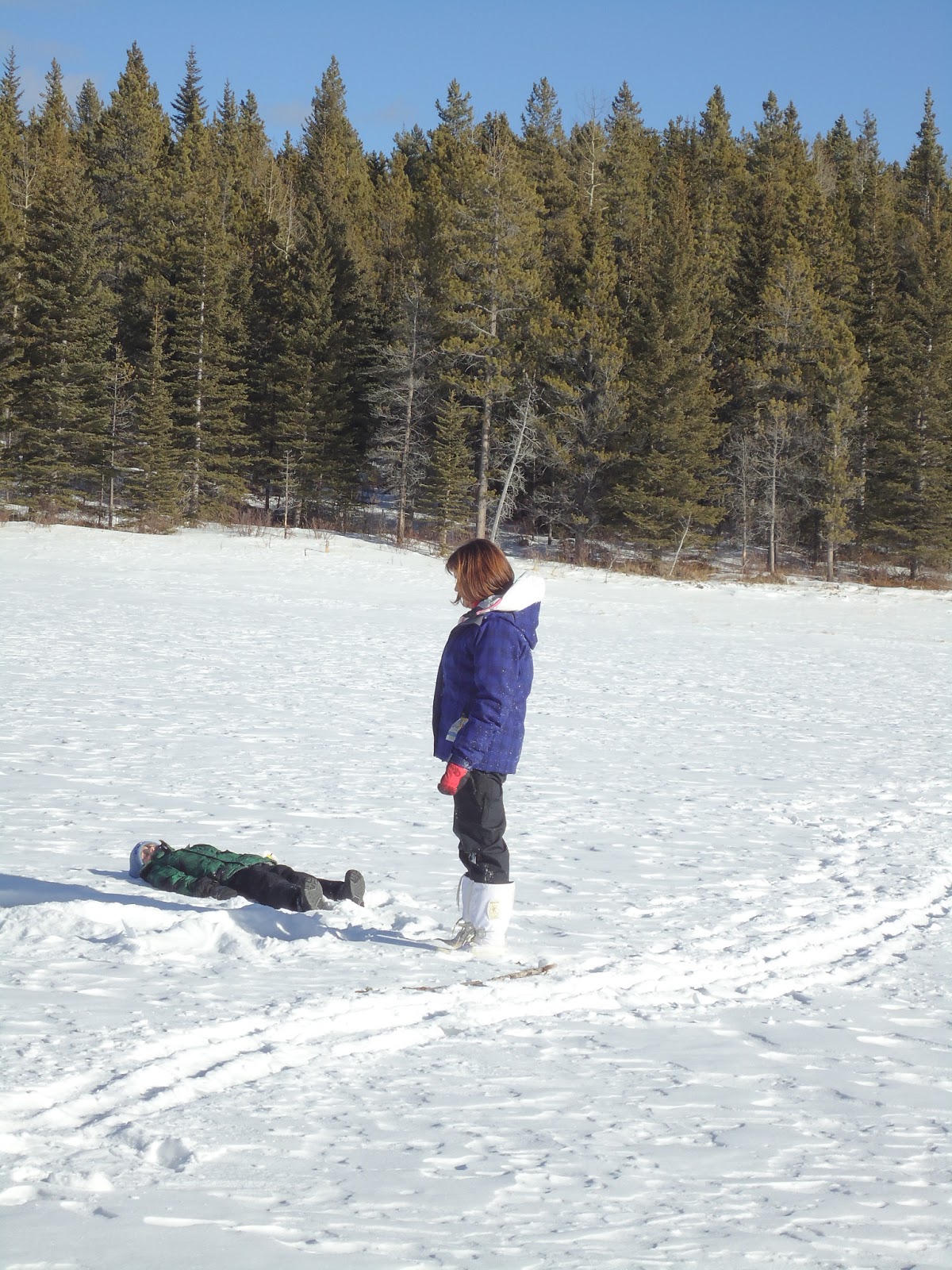
Stand up! You're going to get snow in your boots.
The only thing worse than cold wet feet are cold frozen feet. A successful kids snowshoe trip starts with the kids wearing the right foot wear. While I've suggested in a past post on kids hiking gear that kids don't necessarily need hiking boots, equipping them with the right boots on a snowshoe trip can make the difference between a fun winter outing and a painful, cry-filled experience or worse—a trip to emergency for frostbitten toes.

If preventing kids from crying isn't enough, think of boots like sunscreen. Just like a bad sun burn early in life increases your chances of skin cancer later on, getting frostbite once increases the likelihood of getting frostbite in the future. Long-term effects of even a single case of frostbite include heightened sensitivity to the cold, numbness, stiffness, chronic pain and amputation. It doesn't get any longer term than having your toes cut off when you're a kid.

Didn't you hear what I told your brother about lying in the snow?
Here are some tips on how to choose a boot that's appropriate for snowshoeing, as well as shoveling snow, and playing king of the snow pile at school:

Temperature rating—If the boots don't have a temperature rating, don't buy them. No rating can be a sign that the boots aren't intended for extended forays into the cold. Look for a boot rated to -20 C/-5 F or lower. It's best to err on the side of too warm than too cold. Everyone's different, and what will keep some kids' toes toasty at -20 C will let others' toes freeze at -10 C.

I thought I told you to get up!
No hiking boots—On warmer days, an adult can get moving fast enough to keep his/her feet warm enough in hiking boots. Kids on the other hand generally move slower and stop more. This means their bodies aren't producing as much heat, and their blood isn't circulating that heat to their hands and feet as efficiently. (The stopping can also keep parents from moving enough to stay warm, so you might want to forgo the winter hiking boots, too.) Hiking boots also have low cuffs, but more about that below.

High cuffs—The higher the boot goes up your kid's legs, the better. Snow up to your ankles will go halfway up the calf of 6-year-olds and right down the cuffs of their boots. Once their socks are wet, the fun is over and the clock is ticking on how quickly you can get back to the car.

Are any of you even listening to me? So help me, if you get cold feet...
Drawstrings on the cuffs—These are far from perfect, but they'll keep some snow out of your kids' boots. Just remember to tighten them before you hit the deep stuff. And make sure snow pants are pulled over the boots, not tucked in.

Waterproof—You'd think it would go without saying, but make sure the boot is waterproof. Many winter boots are made of materials that will actually soak up water. Or they're made with waterproof material, but leak through the seams.

Finally, don't over-tighten your kid's snowshoe harnesses. They can be wearing the warmest boots you could find, but their feet will still freeze if the harness is cutting off the circulation to their toes. Also, bring extra socks and dry footwear for the drive home. There's nothing in the backcountry as ornery as a bored kid with wet feet.

Field Tests:

Mack and Michael have field tested a lot of boots. Three brands that have consistently kept their feet warm and dry are Baffin, Sorel and Kamik. Unfortunately, the Schmaltz family gear suppliers are too cheap to shell out for those fancy new neoprene boots like Bogs, so the boys can't comment on how warm they are. But my guess is that the big pull holes on either side and lack of drawstrings would soon let in the snow.

Need help picking out kids snowshoes? Read this post:

Kids Snowshoeing Gear: Picking out Kids Snowshoes

Wondering where to go snowshoeing with kids? Read these posts:

Snowshoeing with Kids in Kananaskis: River View Trail
Snowshoeing with Kids in Banff: Lake Minnewanka
Snowshoeing with Kids in Kananaskis: Hogarth Lakes
Heli-snowshoeing with Kids in Kananaskis
Snowshoeing with Kids in Kananaskis: Canyon Creek
Snowshoeing with Kids in Kananaskis: West Bragg Creek


Anatomy of a good boot by Baffin: -60°C/-76°F Rating (for the family that vacations in Antarctica), high cuff, drawstring, waterproof.

Sunday, 20 January 2013

Kids Snowshoeing Gear: Picking out Kids Snowshoes

MSR Shift snowshoes in action
The question of how to pick out a kids snowshoe came up on the discussion board of the Mountain Mamas (& Papas). When I started snowshoeing in Scouts, you had two types to choose from: oversized wood and sinew tennis rackets, and longer wood and sinew "Iroquois" style snowshoes. Both had leather bindings that were prone to icing up. There were no spikes or teeth or fangs on the bottoms. There were no step-in bindings that you tighten by turning a knob.

Good traction makes a big difference on hills
For snowshoes, as with most things, I prefer simplicity. Fewer moving parts mean fewer things to break or freeze up in the backcountry. I also prefer snowshoes with good traction. Even if you aren't going to be climbing mountains, having enough teeth on the bottom of your snowshoe will let you go up moderately steep hills with ease and descend them without your snowshoes slipping out beneath you. Many is the time I've watched people on cheap rented snowshoes slide their way down from Rummel Lake or Chester Lake, never to go snowshoeing again. The right snowshoes will increase the odds of your kids snowshoeing more than once.

My snowshoes are MSR Lightning Assents. They have aggressive traction built into the frames, in addition to toe crampons and cross bars with teeth, and heel lifts that make going up steep hills feel like climbing stairs. They're fantastic, but you can spend half the money and get a great snowshoe with many of the same qualities. The heel lifts are a nice-to-have, but most people don't need them and even fewer actually use them. For adults, the MSR Evo or Evo Tour (approximately $139 and $169) are great, and I bought my kids (8 and 12) MSR Shifts ($90). For younger kids, I'd recommend the MSR Denali Tyker ($60). I've seen them in action against other snowshoes in what I'll call the "mini" segment of the market, and toddlers on Tykers seem to be able to go a lot farther.

MSR Shift Snowshoes for kids. Note the two traction bars and teeth at the toes.
The bindings on all of these snowshoes are simple rubber straps that aren't prone to icing up and that even kids can get on and get off. They're also very light weight snowshoes. Best of all, they're no more expensive than other snowshoes, but can increase your odds of having a fun time.

Wondering where to go snowshoeing with kids? Read these posts:

Snowshoeing with Kids in Kananaskis: River View Trail
Snowshoeing with Kids in Banff: Lake Minnewanka
Snowshoeing with Kids in Kananaskis: Hogarth Lakes
Heli-snowshoeing with Kids in Kananaskis
Snowshoeing with Kids in Kananaskis: Canyon Creek
Snowshoeing with Kids in Kananaskis: West Bragg Creek

Note: MSR didn't pay me anything to write this review.

Thursday, 26 July 2012

Kids hiking gear: Do they really need it?

Mack in Gore-tex and hiking boots.
Yesterday I snuck out for an early lunch to look at daypacks at MEC (I have a 28L, a 50L and an 80L, but I could use a 40L. Sometimes the 28L is too small, the 50L is too big and something in between would be just right...but that's another blog post). While I was looking quite nerdy bouncing around with a Spirit 40 loaded with some weight to see how it fit--how does it feel if I jiggle like this? How about if I lunge?--I ran into two women from work. The daughter of one needed kids hiking gear for summer camp, but the mom didn't know anything about packs, sleeping bags and all the rest of the stuff on the equipment list. The other woman, who hikes with her kids, came along to help her out.

All went well until the boot section. The one mom simply didn't have enough money to buy the "hiking shoes or boots" that were on the required gear list for a three-day backpacking trip that was part of the two-week camp. Her daughter would have to make do with running shoes. The other woman was aghast. Footwear with the word "hiking" in the name was absolutely required. She would bring a pair of kids hiking boots that her daughter had outgrown and "should" fit the camp goer...to which I quietly disagreed. Runners that fit would be much better than hiking boots or shoes that don't. After all, the list said "hiking shoes" would be acceptable, and most hiking shoes are just gussied up running shoes. Ill-fitting hiking boots lead to ill-feeling, blistered feet. In the end, the mom was confused, didn't know what to do, and took the cheaper route. Running shoes it was.

Michael: cotton & runners. Mack: cotton & boots. Both: survived the ordeal.
I bring this up because parents often ask me about kids hiking gear: what do they need. Already tapped out by school fees, sports fees, camp fees, you-name-it fees, the thought of shelling out for kid-sized Goretex, hiking boots, packs, dry fit shirts, hiking shorts, fleece and on and on actually prevents some from taking their kids hiking. It's not necessarily that they've bought into the hype, but they walk into MEC and, if they're aren't hikers themselves, they're overwhelmed. They don't know what all the stuff is or whether their kid needs it, but one look at the price tag says they can't afford it.

My response: get all that stuff if you can afford it, but don't worry if you can't. It can be helpful, but most of it isn't essential. Lo these many years ago when I was a kid in Scouts, we regularly went hiking, backpacking and scrambling in running shoes, jeans and cotton t-shirts and hoodies (kangaroo jackets back in the day). I don't recall anyone dying of hypothermia because their cotton clothes weren't wicking moisture away, or breaking ankles because their delinquent parents were too cheap to shell out for the heavy, blister-inducing all-leather boots of the day. When I take my kids out, sometimes they wear runners and sometimes they wear their hiking boots. It's up to them. I'll pack their rain coats (my 12-year-old does have a Goretex jacket; again, that's another post, but having the same gear as their parents can help kids develop a passion for the outdoors), but if they bring a cotton hoodie instead of their fleece I don't freak out.

The point I'm trying to make is that, like many simple things in life, we've made hiking more about the cost of the gear than the value of the experience, especially when it comes to kids. Aside from gas money to reach the trail, hiking is essentially free. Whether your kids have Northface hiking pants or blue jeans from Walmart, the important thing is to get them out.

Wednesday, 22 June 2011

The Tyranny of Trekking Poles

A couple years ago, I was with a group ascending Sarrail Ridge in Kananaskis. About halfway up, I heard a loud snap behind me. When I turned around, a somewhat heavy-set hiker was holding half a trekking pole. He'd been leaning heavily on the $200-plus carbon fibre pole when it snapped under his weight. The look on his face was one of shock and, dare I say, horror.

"I have to turn back," he said.

"Why? What happened? Are you hurt."

"My hiking pole broke," he said, looking at me like I was an idiot. "I can't go up a hill this steep without it. How would I get down? I wouldn't be able to balance."

I looked down at my hands, which were conspicuously sans poles. I thought about saying something witty like, "I'm doing okay without them," or "The same way you'll get down from here without it" or even "Huh?" Instead, I held my tongue. After all, how can you argue with someone who has bought into the tyranny of the trekking pole? And, I have to admit, the sight of him virtually crawling down the slope in the new, pole-less world he found himself was quite entertaining.

Since this incident, I've taken note of the many forms that the tyranny of trekking poles can take. I've seen hikers on a flat trail dutifully swing their arms forward and back, focusing on their poling form so much that they repeatedly plant their poles where they get stuck under dead fall and in shrubs, almost yanking their arms out of their sockets. I've seen scramblers concentrating so hard on where they're planting their poles on rocks that they lose track of where they're putting their feet, stumble and tumble down the slope. And I've seen other scramblers reaching to the sky in order to plant poles that are adjusted far too long for the angle of the slope, pulling themselves up the mountain with the small muscles of their arms instead of pushing with the larger muscles of their legs.

For the record, I own trekking poles. Sometimes on a steep slope I'll use both, but I'm much more likely to use one extended to the length of an ice axe for balance. I've also seen others use them effectively on the descent to take some of the load off of their knees and hips. But for the most part, I see people using them not because poles make hiking or scrambling easier, but because they think they have to use them, even if somewhere in their minds they know they don't.

The same can be said for countless other gadgets that too many hikers think they need: GPS, water filers, Spot SOS devices, altimeters, and on and on. When used correctly, all of these can be helpful and even provide a higher level of safety. But when leaned on like a crutch, they actually put you in more danger. What happens when the pole snaps on rocky slope and you don't know how to get down without them? Or the GPS fails and you didn't take enough note of the trail to find your way back? Or the water filter doesn't work and you don't know how to tell safe water from bad?

Worse, for me anyways, is that these devices all too often distract from the experience instead of adding to them. For me, going to the mountains is all about getting away from our reliance on technology and gadgets, and pursuing something more natural. Wandering through the wilderness as humans have for millenia and as I did as a child, engaging all of my senses, heightening my awareness of my surroundings, feeling fear and bliss every now and then, and truly experiencing the moment I'm in.
Related Posts Plugin for WordPress, Blogger...