Showing posts with label Raising Outdoor Kids. Show all posts

Saturday, 2 August 2014

Hiking with Kids at Mt. Assiniboine: An amazing backcountry experience for the whole family


On the Nublet, Mt. Assiniboine in the background.
Something amazing happens when you and your kids are dropped off by a helicopter in the backcountry with no TV, no wifi and no way to charge cell phones. The whole family is forced into the moment...adventure unfolds naturally, you have the kind of talks that only happen on the trail, and you truly get to experience and enjoy each other's presence.

That's what happened when Mack, Michael and I stepped into the helicopter at the Mt. Shark helipad and stepped off it at Mt. Assiniboine. After four days with their grandmother in basic old school cabins in Fairmont Hot Springs (where we visited Lussier natural hot springs and went white water rafting on the Kootenay River...even at 80 she's a cool grandmother), I'd booked us for one night camping and one night in one of the Naiset huts at Mt. Assiniboine. I figured if it was raining, two nights stuck in a tent would be miserable for a 9-year-old and a 14-year-old, and the experience would turn them off of the backcountry instead of onto it.

I needn't have worried. We arrived around 12:30 p.m. the first day to sunny skies, and easily made our way on the 2 kilometer trail to the Lake Magog backcountry campsite. There we found a mini-city of backpackers who'd hiked in from Mt. Shark and Sunshine Meadows, some smiling and some the worse for wear. After setting up our tent, we explored a bit, found the outhouses and cooking shelter, and ambled along the shore of Lake Magog back to Mt. Assiniboine Lodge in time for the 4 p.m. tea and cake. Mt. Assiniboine is almost like a backcountry amusement park. Between the posh lodge and its
The first night's campsite.
cabins, the nearby basic Naiset huts, and 30 or so campsites at the Lake Magog campground, there must have been a hundred or so people wandering the trails and meadows in the immediate vicinity of the mountain. For an introduction to the backcountry, this makes it a safe place for novices of all ages. You can rough it as much or as little as you want, and if the kids are resisting the wonder of it all there's the daily bribe of a Coke and cake to focus them on. After finishing off two plates of the fresh baked banana bread and chocolate cake, we returned to our campsite under increasingly cloudy skies.
Breakfast the second day.

We heard the first thunder clap as we started up our Pocket Rocket camp stove, but the rain held off until we were finished the main meal and the last kernels of our Jiffy Pop popcorn were popping. If you want to turn your kids into celebrities at any campsite, Jiffy Pop is the way to go. Despite the rain, Mack and Michael were grinning ear to ear when they realized all eyes were enviously on them and their rarest of delicacies in the backcountry. Forget all the fancy backcountry deserts in the freeze dried food section of MEC or REI. Jiffy Pops are fun to make and even more fun to eat than a foil bag of something grossly mislabeled as "Chocolate
Mousse with Chocolate Crumble Topping."

By eight we'd crawled into our tent with the pitter patter of the rain on the fly. I'd brought a deck of cards, but we didn't need them. The kids loved just sprawling out, telling jokes and relaxing to the pitter patter of the rain on the fly. I loved just enjoying the time alone with them, no electronic distractions and lots of laughing.

The next morning, I crawled out around 7 a.m. to a big blue sky and nothing but birds breaking the silence. While the boys slept in, I fixed coffee on one of the open air cooking pads and enjoyed the
Descending the Nublet
company of a couple retired guys who'd backpacked in with one of their grown daughters. When they'd finished their breakfast, it was a young family with two daughters, 4 and 7, who'd flown in and were going to backpack out the next day. It wasn't until 11 a.m. that we'd finished our breakfast of pancakes and were on the trail for the day's adventure: an easy 500 m scramble up the Nublet, a bump on Nub Ridge on the way to the summit of Nub Peak.

With no schedule other than cake at the lodge at 4 o'clock, we took our time on the 4 km trail, stopping to look at tadpoles in a stream or at the amazing view of lakes below and mountains above. On the last section of actual scrambling just below the top of the Nublet, I marveled at how
surefooted the boys have become on scree, how they naturally test hand holds to make sure the rock is solid...how at ease they've become in the mountains, how great it is to be an outdoor family...On top we enjoyed the views for half an hour, Mack spotted a bald eagle (not that common in the Rockies) and I was the happiest dad on earth.
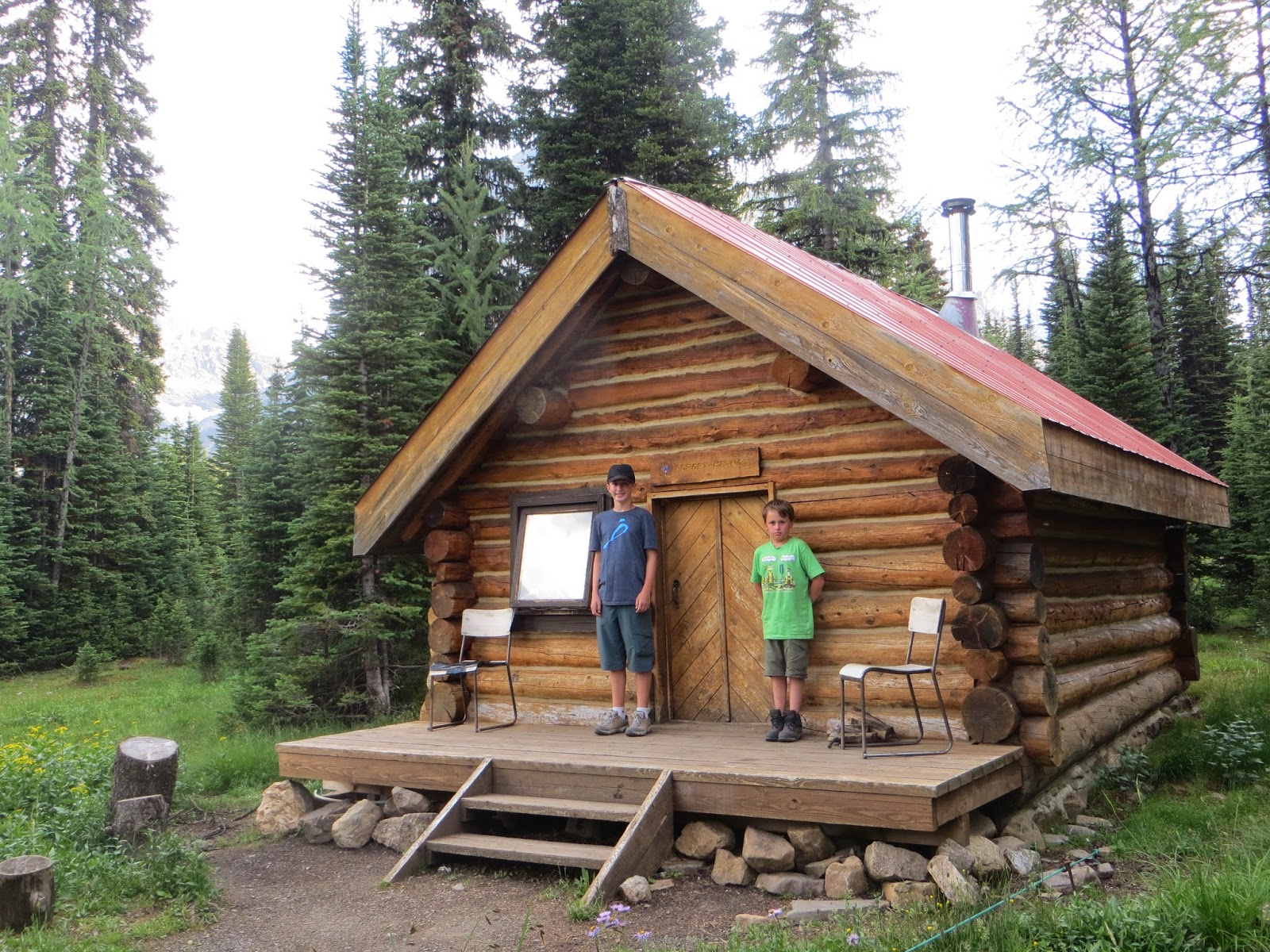
Our hut and its small door.
An hour later we were packed up and making our way to the lodge for a cold Coke and cake. From the lodge we carried our gear the half kilometer to the Naiset huts and started cooking supper in what turned out to be a fully equipped cook hut: running water, propane stoves and lamps, gourmet quality pots and pans...not bad for the backcountry! That left us a few hours to explore before sunset and bed, and there was lots to explore. We got our feet wet hopping across and through the creek that leads down to the lake, got them wetter wading in the lake, and had fun doing nothing but having fun. When we finally went back to the hut, we found our hut mates already in their sleeping bags trying to sleep (sorry!) and more or less quietly climbed into our own bags. Even getting up at 2:30 a.m. to go to the outhouse with Michael was an amazing experience, stepping out of the hut's pitch black to a dark sky filled with millions and billions of stars filling the mountain sky.

Waiting for the helicopter the next morning, I couldn't help but think about what an amazing time we'd had. As exciting as flying in a helicopter is for a kid, for Mack and Michael it paled in comparison to things like playing in the lake as the sun set, reaching the top of the Nublet and, for Mack, being the first to spot the bald eagle. Originally, I'd been a little disappointed when I saw how many people would be sharing our backcountry experience, but that had given way to another welcome lesson in letting go of expectations and accepting what the mountains give you. The boys had been exposed to new aspects of mountain culture--sharing a cooking pad and a hut, cook shelter etiquette, meeting fellow campers--and they'd thrived in it. And that's what the
mountains are all about regardless of how old you are: taking what they give you and thriving in it all.

 
Sunset at Mt. Assiniboine.
Morning visitor at our hut.

A happy dad on the flight out.


Wednesday, 22 January 2014

Raising Outdoor Kids: 3 ways you know it's working


1. Being an outdoor teenager provides social status. My oldest son is in the 8th grade, and one of his friends is selling home made survival bracelets to help pay for his older brother's Scout trip to Japan. "You could tell who the hikers were," he said. "We could see all kinds of ways you could use it. Zane asked how it protects you." You're correct if you guessed that Zane doesn't hike.


2. They announce they're moving to the mountains. "When I move out, I'm moving to Banff," my 9-year-old son announced one day. "It's right in the mountains, and there are lots of trails everywhere." Later that day he also announced that when he was in high school he was going to live with me, sleep on the couch all day, and I'd have to feed him. Both of his announcements sound good to me!

3. The presents they give you are really for them...and they're for camping. That's what happened a couple birthdays ago when they gave me backpacking pots, plates, bowls and mugs. "We can take them when we go camping," one said. "Look how the mugs and stuff all fit together. It's pretty cool." Yes it is, but not as cool as the fact that he said that. And much cooler than the Skylanders his friend George gave his father.


Tuesday, 14 January 2014

Raising Outdoor Kids: Scrapes, scratches, bruises and non-fatal cuts build character


I came across an article today titled Barrier to Active Play: Safety Concerns. The thesis of the article is that one of the biggest barriers to kids playing outside is their parents' fears of kids hurting themselves, being abducted by strangers, or struck by lightening a split second before a meteor falls on them.
If you're a parent, this is nothing new. Let your kids play unattended in your front yard and you run the risk of Social Services taking them away to live in the custody of the state where they'll be safe. Or worse, the neighbors will look at you with their eyes askance. Yet we all know that sheltering our kids from irrational dangers that we know exist only in our heads isn't healthy for them. It robs them of the experiences they need to learn how to identify risks, develop their sense of independence, gain the resilience to keep playing when they scrape a knee, get some exercise...In other words, it robs them of the experiences they need to become the independent, well-adjusted individuals we want them to become.

This isn't something that outdoor parents leave behind in the city when we take our outdoor kids into the wilds and reintroduce them to the food chain. I've seen parents, who themselves take risks with severe consequences in the mountains, berate their child for stepping in a creek or happily hopping across boulders...Be careful! Watch your step! You're going to fall and scrape your knee! See, you fell. I told you to watch your step. Why were you watching me?

Don't get me wrong, I'm not perfect when it comes to letting my boys do something I know has a greater than 50/50 chance of spilling blood. But I've learned the hard way in soooooo many areas of life that we all have to learn our own lessons. And one of the reasons I take my sons to the mountains is so they can learn their own lessons. Unless I think a bone is going to be broken or worse, I usually let things unfold as they were meant to. Just as I learned from every scraped knee, scratched shin, bruised buttock and cut finger from the Rocky Mountains to the West Coast Trail (seriously, I was 12 when I hiked that thing...what were my parents thinking?), my sons are learning how to identify risks and decide to either take them or avoid them.

Sometimes taking the risk works out, and sometimes they leave a little bit of themselves on the trail. Either way, they keep going. They don't let a little pain or a little scratch stop them. And at the end of every hike I can see the independence and confidence they've gained, and how they bring that back to their day-to-day lives in the relative safety of the city.


Saturday, 11 January 2014

Raising Outdoor Kids: Go on a techno-fast and let boredom works its wonders


"Go on a techno-fast. Research shows that multitasking can divide attention and hurt one’s ability to learn and create. Children and parents need a break, and nature is the best place to take it. Set aside times in the day and every week — or a whole week or more — to leave the electronics behind. Exit the virtual and enter the real. Spend a little time in the Cascades, your yard or even the English countryside. Your kids may complain at first, but they’ll come back from the break feeling better. They’ll notice it. So will you."

This was tucked away at the end of an article titled "Forward to Nature: Why a Walk in the Woods Could Calm ADHD, Make Your Family Happier and Deliver Your Kid to Harvard" by Richard Louv. In a nutshell, the article articulates the health and other benefits of getting children into nature: lower rates of depression and negative stress, reduced symptoms of ADHD, improved academic performance, the list goes on. If you're reading this, you're probably already aware of all this. (Us outdoor parents tend to spend a lot of time preaching to the choir about this stuff.) What really caught my attention was the section at the end of the article that listed easy ways to "Reclaim Nature." Go on a techno-fast was one of them.

As it happens, my teen-aged son is on day 6 of a school project in which he had to give up electronics for a week. After an initial increase the frequency and duration of fights with his little brother, he settled into a pattern of sustained boredom interspersed with shorter periods of fighting with his brother. So last night I handed him my old copy of Into Thin Air, and he actually read it. Reading on its own isn't new for him. He's always enjoyed books like Diary of Wimpy Kid or The Hunger Games. Age appropriate stuff. This was the first adult book I'd suggested he read. It was also the first non-fiction book, aside from kid classics like The Scoop on Poop (there are two; I recommend the newer one).

Then this morning he recommended that we go cardboard tobogganing again. This was new. Seldom does he suggest going out to do that kind of stuff any more. So we took the cardboard toboggans out and had a blast, even though the snow was wet and slow. And when the cardboard was too wet and bent to slide at all, we used them as forts and had a snowball fight. It was all fun, spontaneous and driven by the boys, not me.

And then, after we'd come in, dried off and warmed up, he went out and threw snowballs for the dog in the backyard for an hour. I don't know what suddenly got into him, but I know what didn't: two-dimensional digital stimulation. Or maybe I do know what got into him: boredom. Good clean old-fashioned boredom, and it was the best thing that's happened to all of us in a while.


Friday, 3 January 2014

Avalanche Awareness Days are Here! Check Out an Event at a Canadian Rockies Location Near You


It's winter and once again the Canadian Rockies are having a bad avalanche season that the Canadian Avalanche Centre thinks may get worse. As I write, the avalanche forecast for Kananaskis tomorrow is high above treeline, considerable at treeline and moderate below. I was going to lead a snowshoeing trip up Black Prince Outlier in Kananaskis, but decided to move the trip to the safer and relatively flatter Chester Lake.

You can never learn enough about avalanche safety, and it's never too earlier to teach your kids. Fortunately, Avalanche Awareness Days are coming to a number of Canadian Rockies locations. Each event has different activities, ranging from shovelling races and avalanche terrain talks to demonstrations of dog rescue teams doing their things.

For more information, go to the events section of the Canadian Avalanche Centre website.

Avalanche Awareness Days Dates

Banff--January 18-19, 2014
Kananaskis/Burstall Pass--January 19, 2014
Nakiska Ski Resort--January 18, 2014
Lake Louise Visitor Centre--January 16, 2014
Lake Louise Ski Resort--January 18-19, 2014

For more avalanche education information, read these posts:

Kids Outdoor Skills: Age-Appropriate Avalanche Safety Education
Kids Outdoor Skills: Avalanche Safety Video for Teens

Monday, 30 December 2013

Old School Outdoors: Retro sliding with cardboard toboggans


Yesterday after tubing at Norquay, we went into the day lodge for hot chocolate. At some point, one of the boys pointed out a poster announcing an upcoming cardboard toboggan derby. I didn't think about it again until we got home and they announced that they wanted to make their own cardboard toboggans.

So I went into the basement and pulled up a couple big sheets of cardboard that their bedroom furniture had been delivered in. Then, being the over-thinking adult of the family, I went online to find photos of cardboard toboggans to see how to make them. By the time I looked up from the screen, the boys were already cutting and taping. So I closed Google Images, shut up, and let them create.

The results? The old school cardboard toboggans slid better than 90% of the fancy plastic store-bought sleds we've tried over the years. We spent at least an hour going up the little hill behind my house, sliding down on the toboggans and our butts, getting snow up sleeves and down necks. When we were finally too cold to continue, we reluctantly headed back home, upon which a certain teenager was heard to say, "I can't believe we had that much fun with just pieces of cardboard."


Basic but effective

A little less snow in the face thanks to the deflector in front (the uphill end)

Tuesday, 24 December 2013

3 Things to Rember When Your Kids' Sports Come Between Your Family and the Outdoors


There are many benefits to kids playing organized sports. They learn teamwork, discipline and how to operate within the defined framework of rules. They develop their fine and gross motor skills, get active, and build confidence and self-esteem. Organized sports can be a lot of fun, too.

There are also many benefits to taking your kids hiking, snowshoeing, skiing and an endless number of other outdoor activities. They learn self-reliance and reliance on the group. They learn through unstructured experience. They develop their fine and gross motor skills, get active, and build confidence and self-esteem. They also develop a relationship with the outdoors and the environment that connects them to the world around them, and that can ground them in hard times and good. It's fun. I could go on, but you get the idea.

As an outdoor dad and a soccer coach dad to my two amazing sons, I can personally attest to how hard it can be to balance the organized and the outdoors. Organized sports, exactly because they are organized and scheduled, all too easily take priority. Especially when you're the coach. And when one of your sons plays on Saturdays and the other plays on Sundays. A game at 1 p.m. on Saturday and another at 11 a.m. on Sunday makes it difficult to drive an hour or more to the mountains, get in enough hiking or snowshoeing to make it feel worthwhile, and drive home.

At my older son's last indoor soccer practice before Christmas, we had a parents vs kids game (the 12- and 13-year-olds let themselves get tied by a bunch of old men). Afterwards, a few of us dads got talking about how being a soccer parent changes your life. They know I take my boys out to the mountains a lot, and asked how I balance that with practices and games three days a week. I'm not sure I gave them a very good answer at the time, but it got me thinking. How do I balance the outdoors with organized sports? These are the three things I came up with and that I have to consciously remember to remember:

1. The drive is worthwhile

Even a couple hours in the mountains is worth the drive. Just like I can see the pride in my sons' faces after a good game, I can see how at ease and relaxed they are after a couple hours in the mountains. Just as importantly, I can feel how my own batteries are recharged.

2. You don't always have to drive far to get your kids out


I'm willing to drive a little further to get away from the more crowded and popular trails closer to the city. In Kananaskis and Banff, the further you drive, the more snow you find in the winter, as well. But if we've only got a few hours after a game, there are plenty of good trails 30 to 45 minutes away in West Bragg Creek, the Elbow Valley, the Bow Valley and the Kananaskis Valley. My boys and I have had as much fun snowshoeing down a snowless-but-frozen Canyon Creek in Elbow Valley as we have floating on a meter of fluffy powder another hour's drive west in Peter Lougheed Provincial Park.

3. Take what you can get, when you can get it

Some days, even that 45-minute drive to West Bragg Creek to snowshoe just isn't possible. But a quick and fun snowshoe or walk up Nose Hill, a five minute drive from my house, is. On those days, I have to remind myself to take what I can get. Calgary is fortunate to have a wealth of large urban nature parks to play in, as well as a river pathway system that provides lots of opportunities to play in nature. Even taking the dog to an off-leash park like Edworthy, with its trails through the aspens and ravines, provides a solid dose of Vitamin N when soccer makes a trip to the mountains impossible.


Wednesday, 16 October 2013

Happy NeighborWoods Month! Go Outside and Hug a Tree on Your Street

Didn't know October is National NeighborWoods Month? Neither did I until I stumbled across it online.

This fall I made three separate journeys into the Rockies in larch season and watched their progression from green to gold over the course of a month--Snow Peak via Burstall Pass, Chester Lake and the Elephant Rocks, and Little Arethusa--but barely noticed that the trees in my front yard are losing their leaves. Yet the mature trees that line my street are one of my favorite things in the neighorhood. They make the street feel comfortable, livable, like home. Even on the greyest winter day, their stark naked branches are reminders that spring and green leaves are on their way. And the boys are forever finding things to do with the branches that fall on the ground, many of which are new and innovative ways to get under their father's skin.

It's too late in the season to plant a tree in Calgary to celebrate NeighborWoods Month, but it's never too late to post my favorite urban tree photos and hug spruce trees in my backyard.


Little Arethusa and golden larches under a layer of snow.

Tuesday, 8 October 2013

Let's Make Getting Outdoors and Active Fun for Our Kids Again


"If a school day is six hours then at least two should be set aside for hiking, biking, skiing, skating, sports or whatever it is that kids like to do and can do. Because that’s the secret, and the antidote to all this gym-oriented, heart-rate-monitor-wearing unsuccessful “fitness” blathering. Teaching kids that activity is fun, that being able to do what you want physically is important, and that it matters both individually to long-term qualify of life and collectively as the cause of massive wastes of tax dollars."

When I read that, I was on a treadmill at the gym. I wasn't wearing a hear-rate monitor, but I may have been holding onto the heart rate sensors. And I was in the new Youth Wellness Center of the Westside Recreation Center in Calgary that's restricted to kids aged 13 to 18 from 3:30 p.m. to 8 p.m. I was getting in shape, but I wasn't having fun.

As I looked around, I realized that I was surrounded by the spandex-clad specimens of the near perfect human forms that Gadd talks about in his article. I am not a near perfect human form, and I don't think I ever have been. I generally carry a few extra pounds around the waist. When I recently lost 20 pounds (although the Divorce Stress Diet is effective, I don't recommend it), I realized I was also carrying a few extra pounds all over my body: cheeks, pecs, legs, back, buttox, everywhere.

For me, working out at the gym isn't an end to itself, whether that's weight control or making sure I look good in a bathing suit. It gives me the basic level of fitness I need to enjoy myself hiking, snowshoeing, scrambling, and doing a bunch of other activities in the mountains. It helps me have fun outside of the gym.

Fun. In the end, that's what it's all about. When I coach my sons' soccer teams, I stress fun because I've seen what happens when soccer isn't fun: kids stop playing. When I take my sons hiking and snowshoeing and I lead kids hikes for my outdoor group, I stress fun because I've seen what happens when hiking isn't fun: the kids don't want to come out any more. Worse, they learn that hiking and active living in general aren't fun, which decreases the chances of them growing up into active adults.

As parents, our job is to help our kids grow up into adults that are healthy physically, emotionally, and intellectually. Yet, as Gadd points out, the focus all too often is on the intellectual, which we abdicate to teachers and schools to look after. Physically? That's up to our kids' phys-ed teachers and sports coaches and doctors. Emotionally? When was the last time you asked your kids how they're feeling and why they feel that way?

Getting kids outside on a regular basis, whether it's hiking in the mountains or running around an urban nature park, and just letting them have fun is one of the most powerful ways we can address their physical, emotional and intellectual health. It gets them active and teaches them that being active is fun. The emotional benefits of being in nature are well documented: stress levels decrease while things like self-confidence and self-awareness increase. And it instills in them an intellectual curiosity about the world around them that they don't get sitting in a classroom. 

If you're reading this, you know what I'm doing to get my two sons outside and active. Leave a comment below to let us know what you're doing, and we can share ideas.


Thursday, 12 September 2013

Helping Kids Understand the Risks that Outdoor Parents Take is an Ongoing Process


One of the smaller crevasses on Antisana

“Few places in this world are more dangerous than home. Fear not, therefore, to try the mountain passes. They will kill care, save you from deadly apathy, set you free, and call forth every faculty into vigorous, enthusiastic action.” 

― John Muir

“Climb if you will, but remember that courage and strength are nought without prudence, and that a momentary negligence may destroy the happiness of a lifetime. Do nothing in haste; look well to each step; and from the beginning think what may be the end.” 
― Edward Whymper


5707m on the summit of Antisana
The subject of outdoor parents and the risks we take has been coming up in a group of outdoor family bloggers of which I'm a member. I've written before about the risky stuff I do in the mountains and how that relates to being a parent. But as my sons get older and I expose them to more of the outdoor community and culture of which I'm a part, and they build their own bonds to that community, I've been realizing that I have to revisit the subject on a regular basis. 

Also, as I help them process the changes and feelings they're experiencing as a result of their mom and I beginning the divorce process, I'm strongly aware of their need for stability and security in their relationship with their parents. And by asking them how they feel about those changes and letting them know that there are no right or wrong feelings and they don't have to worry about hurting me, I'm finding that in some ways we're developing closer bonds as a family of three than we did as a family of four. It's taking time, but they're starting to open up to me about their feelings in general and I don't even have to prod them. They're even answering questions about school with full sentences instead of single word grunts.

It doesn't get much safer than top roping
Last Saturday night we went to the Best of the Vancouver International Mountain Film Festival. The film I most wanted to see was Shattered by climber Steve House. Besides the amazing cinematography and ice climbing, House reveals a vulnerable side that is rare in the ego-driven world of world-class mountaineering. He shares that his deepest fear is that he isn't worthy of love. That 19 climbers he's shared a rope with have died. That he's increasingly aware that each moment on a mountain could add him to that list. 

That night Mack, my oldest at 13, said it sounded like House didn't like climbing, so why did he keep doing it? That started a fantastic conversation about the difference between irrational fear and recognizing that you're in danger. About what drives people to do risky activities. About why I do risky activities. Then Michael, a wiser 9-year-old than he often gives himself credit for, noted that 19 of House's friends had died climbing. The message was clear: he was concerned that I could die climbing.

This is increasingly one of my concerns as well, especially as I plan another trip to Ecuador to climb 6,268m Chimborazo. The more I push myself to the edge, the farther out I find I have to push myself to get the same clarity of the moment and self realization. Nothing forces me into the present moment--hyper-awareness of all of my senses, each step and plant of my ice axe excruciatingly deliberate--like knowing that the consequences of a mistake would be severe. Last year I found this clarity on Ecuador's 5707m Antisana as I traversed beside a gaping crevasse the width of a house and so deep I couldn't see the bottom. Between my boot and the drop was no more than a couple inches of snow. If I fell, it was unlikely the picket that was sticking half out of the snow beside me would hold or that Estevan would be able to arrest my fall. We'd both disappear into the glacier. In the preceding 24 hours I'd only gotten two hours of sleep, I was exhausted from six hours of slogging up steep snow with some ice thrown in, and I hadn't acclimatized well to the noticeable lack of oxygen at that altitude. Yet I felt a clarity and presence in the moment unlike anything I'd felt before.

But that is not something you can explain to a 9-year-old or even a 13-year-old. It's not something that most of my middle-age hiking friends understand. So I showed the boys photos of the ice climbing I do, and compared it to what House was doing in Shattered. I showed them photos of people climbing Everest and K2, and photos of the stuff I do. I tried to put into perspective the level of climbing that House's 19 dead rope mates did, and the level of climbing and other mountain stuff I do, but without dismissing the risk or misleading the boys into thinking that nothing could happen to me.

Did Mack and Michael get it? I think so, but I'll revisit the subject in a couple weeks to give them time to process it all and come up with new questions. And if I can swing it maybe I'll take them to Colorado in January, do a little skiing in Teluride, and drop in on the Ouray Ice Festival on the day of the Kid's Climbing College so they can give ice climbing a try for themselves.


Related Posts Plugin for WordPress, Blogger...