Showing posts with label Kids Hiking. Show all posts

Saturday, 2 August 2014

Hiking with Kids at Mt. Assiniboine: An amazing backcountry experience for the whole family


On the Nublet, Mt. Assiniboine in the background.
Something amazing happens when you and your kids are dropped off by a helicopter in the backcountry with no TV, no wifi and no way to charge cell phones. The whole family is forced into the moment...adventure unfolds naturally, you have the kind of talks that only happen on the trail, and you truly get to experience and enjoy each other's presence.

That's what happened when Mack, Michael and I stepped into the helicopter at the Mt. Shark helipad and stepped off it at Mt. Assiniboine. After four days with their grandmother in basic old school cabins in Fairmont Hot Springs (where we visited Lussier natural hot springs and went white water rafting on the Kootenay River...even at 80 she's a cool grandmother), I'd booked us for one night camping and one night in one of the Naiset huts at Mt. Assiniboine. I figured if it was raining, two nights stuck in a tent would be miserable for a 9-year-old and a 14-year-old, and the experience would turn them off of the backcountry instead of onto it.

I needn't have worried. We arrived around 12:30 p.m. the first day to sunny skies, and easily made our way on the 2 kilometer trail to the Lake Magog backcountry campsite. There we found a mini-city of backpackers who'd hiked in from Mt. Shark and Sunshine Meadows, some smiling and some the worse for wear. After setting up our tent, we explored a bit, found the outhouses and cooking shelter, and ambled along the shore of Lake Magog back to Mt. Assiniboine Lodge in time for the 4 p.m. tea and cake. Mt. Assiniboine is almost like a backcountry amusement park. Between the posh lodge and its
The first night's campsite.
cabins, the nearby basic Naiset huts, and 30 or so campsites at the Lake Magog campground, there must have been a hundred or so people wandering the trails and meadows in the immediate vicinity of the mountain. For an introduction to the backcountry, this makes it a safe place for novices of all ages. You can rough it as much or as little as you want, and if the kids are resisting the wonder of it all there's the daily bribe of a Coke and cake to focus them on. After finishing off two plates of the fresh baked banana bread and chocolate cake, we returned to our campsite under increasingly cloudy skies.
Breakfast the second day.

We heard the first thunder clap as we started up our Pocket Rocket camp stove, but the rain held off until we were finished the main meal and the last kernels of our Jiffy Pop popcorn were popping. If you want to turn your kids into celebrities at any campsite, Jiffy Pop is the way to go. Despite the rain, Mack and Michael were grinning ear to ear when they realized all eyes were enviously on them and their rarest of delicacies in the backcountry. Forget all the fancy backcountry deserts in the freeze dried food section of MEC or REI. Jiffy Pops are fun to make and even more fun to eat than a foil bag of something grossly mislabeled as "Chocolate
Mousse with Chocolate Crumble Topping."

By eight we'd crawled into our tent with the pitter patter of the rain on the fly. I'd brought a deck of cards, but we didn't need them. The kids loved just sprawling out, telling jokes and relaxing to the pitter patter of the rain on the fly. I loved just enjoying the time alone with them, no electronic distractions and lots of laughing.

The next morning, I crawled out around 7 a.m. to a big blue sky and nothing but birds breaking the silence. While the boys slept in, I fixed coffee on one of the open air cooking pads and enjoyed the
Descending the Nublet
company of a couple retired guys who'd backpacked in with one of their grown daughters. When they'd finished their breakfast, it was a young family with two daughters, 4 and 7, who'd flown in and were going to backpack out the next day. It wasn't until 11 a.m. that we'd finished our breakfast of pancakes and were on the trail for the day's adventure: an easy 500 m scramble up the Nublet, a bump on Nub Ridge on the way to the summit of Nub Peak.

With no schedule other than cake at the lodge at 4 o'clock, we took our time on the 4 km trail, stopping to look at tadpoles in a stream or at the amazing view of lakes below and mountains above. On the last section of actual scrambling just below the top of the Nublet, I marveled at how
surefooted the boys have become on scree, how they naturally test hand holds to make sure the rock is solid...how at ease they've become in the mountains, how great it is to be an outdoor family...On top we enjoyed the views for half an hour, Mack spotted a bald eagle (not that common in the Rockies) and I was the happiest dad on earth.
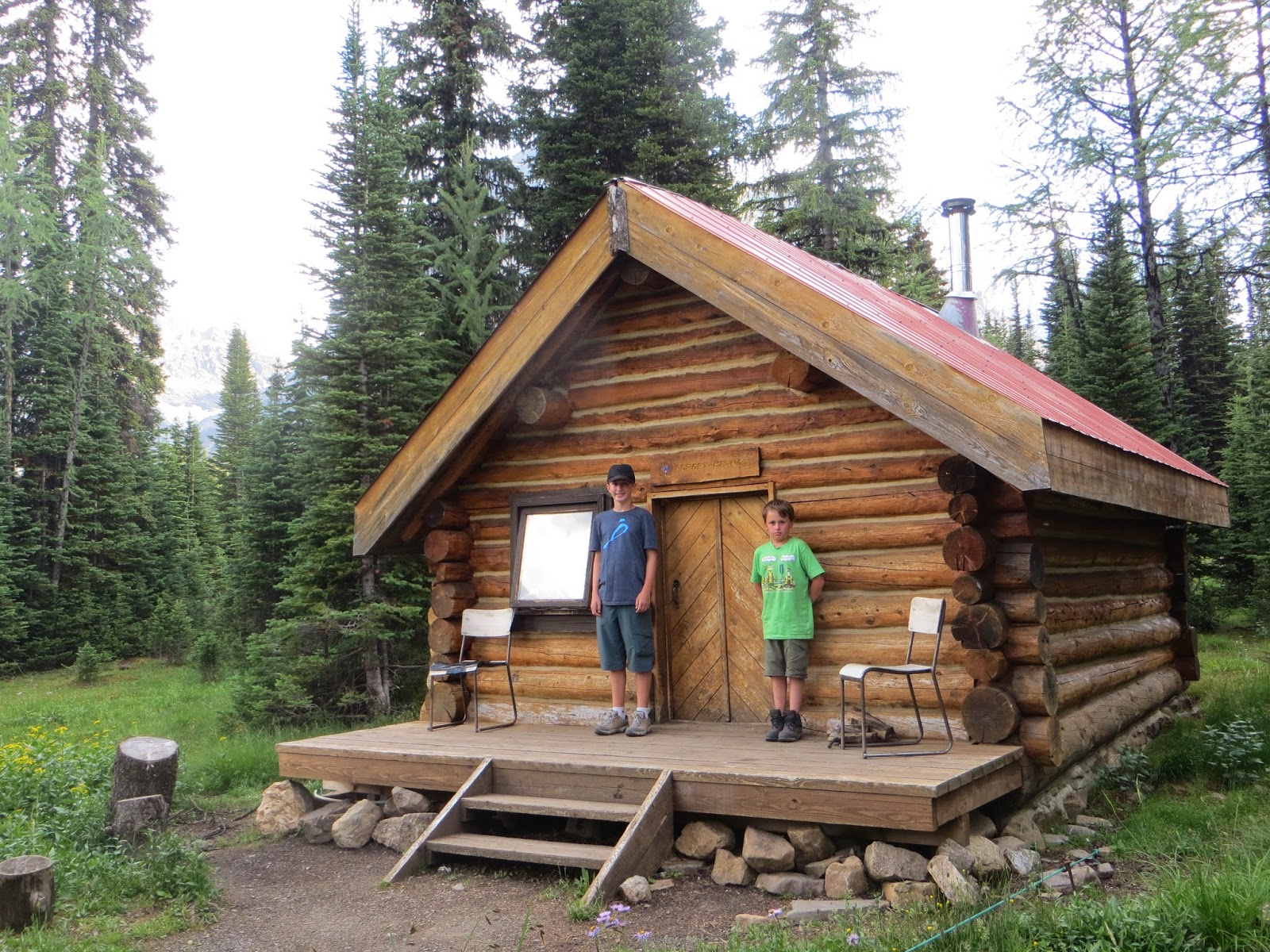
Our hut and its small door.
An hour later we were packed up and making our way to the lodge for a cold Coke and cake. From the lodge we carried our gear the half kilometer to the Naiset huts and started cooking supper in what turned out to be a fully equipped cook hut: running water, propane stoves and lamps, gourmet quality pots and pans...not bad for the backcountry! That left us a few hours to explore before sunset and bed, and there was lots to explore. We got our feet wet hopping across and through the creek that leads down to the lake, got them wetter wading in the lake, and had fun doing nothing but having fun. When we finally went back to the hut, we found our hut mates already in their sleeping bags trying to sleep (sorry!) and more or less quietly climbed into our own bags. Even getting up at 2:30 a.m. to go to the outhouse with Michael was an amazing experience, stepping out of the hut's pitch black to a dark sky filled with millions and billions of stars filling the mountain sky.

Waiting for the helicopter the next morning, I couldn't help but think about what an amazing time we'd had. As exciting as flying in a helicopter is for a kid, for Mack and Michael it paled in comparison to things like playing in the lake as the sun set, reaching the top of the Nublet and, for Mack, being the first to spot the bald eagle. Originally, I'd been a little disappointed when I saw how many people would be sharing our backcountry experience, but that had given way to another welcome lesson in letting go of expectations and accepting what the mountains give you. The boys had been exposed to new aspects of mountain culture--sharing a cooking pad and a hut, cook shelter etiquette, meeting fellow campers--and they'd thrived in it. And that's what the
mountains are all about regardless of how old you are: taking what they give you and thriving in it all.

 
Sunset at Mt. Assiniboine.
Morning visitor at our hut.

A happy dad on the flight out.


Friday, 25 July 2014

Hiking with Kids in Kananaskis: The Vaults of Mt. McGillivray


A giant vault blasted into the side of a mountain, then abandoned and almost forgotten. What's not to get excited about if you're a kid (big or small)?

The Trans Canada Trail
Back in the 50s or 60s, somebody blasted a tunnel and side vaults into the side of Mt. McGillivray in Kananaskis (you can read one theory of who and why here). When I was a kid in the late 70s, getting to them was something of an ordeal. You had to bushwhack to them from the Trans-Canada highway, and if you didn't know where they were you could spend the entire day searching for the narrow entrance and never find it. But if you did know, the short hike through the brush to treeline brought you a place custom designed to trigger a kid's imagination.
One of the washouts

Click here for more kids hikes in Banff, Kananaskis, Kootenay and other areas of the Canadian Rockies. 

Today, you park at the Heart Creek day use area, head west and the Trans Canada Trail takes you most of the way there. Luckily, the floods of June 2013 washed out a couple big chunks of the trail, reintroducing a bit of adventure and effort to reach the vaults. After negotiating your way across the washouts, it's almost impossible to miss the well-beaten path that now leads up to the vaults in a couple gentle switchbacks.

Although the vaults now lack the
Wolf track on the trail
exclusivity of being able to say you went somewhere that 99.9% of even the most experienced hikers have never heard of, they haven't lost any of their ability to spark the imagination.  And, as the wolf tracks we followed down the path, well beaten mountain paths are still wild. Try this hike from spring through to fall when you're looking for a fun, easy way to spend a couple hours in the mountains.

Distance: 3 or 4 km return
Time on the trail: 1-2 hours
Elevation gain: About 100 m

Driving Directions: Trans-Canada west from Calgary to the Heart Creek day use area across from Lac des Arc. Look for the Trans-Canada Trail sign on the west side of the parking lot across from the outhouses.
Click here for a driving map.

The entrance

The "foyer"


Tuesday, 8 October 2013

Let's Make Getting Outdoors and Active Fun for Our Kids Again


"If a school day is six hours then at least two should be set aside for hiking, biking, skiing, skating, sports or whatever it is that kids like to do and can do. Because that’s the secret, and the antidote to all this gym-oriented, heart-rate-monitor-wearing unsuccessful “fitness” blathering. Teaching kids that activity is fun, that being able to do what you want physically is important, and that it matters both individually to long-term qualify of life and collectively as the cause of massive wastes of tax dollars."

When I read that, I was on a treadmill at the gym. I wasn't wearing a hear-rate monitor, but I may have been holding onto the heart rate sensors. And I was in the new Youth Wellness Center of the Westside Recreation Center in Calgary that's restricted to kids aged 13 to 18 from 3:30 p.m. to 8 p.m. I was getting in shape, but I wasn't having fun.

As I looked around, I realized that I was surrounded by the spandex-clad specimens of the near perfect human forms that Gadd talks about in his article. I am not a near perfect human form, and I don't think I ever have been. I generally carry a few extra pounds around the waist. When I recently lost 20 pounds (although the Divorce Stress Diet is effective, I don't recommend it), I realized I was also carrying a few extra pounds all over my body: cheeks, pecs, legs, back, buttox, everywhere.

For me, working out at the gym isn't an end to itself, whether that's weight control or making sure I look good in a bathing suit. It gives me the basic level of fitness I need to enjoy myself hiking, snowshoeing, scrambling, and doing a bunch of other activities in the mountains. It helps me have fun outside of the gym.

Fun. In the end, that's what it's all about. When I coach my sons' soccer teams, I stress fun because I've seen what happens when soccer isn't fun: kids stop playing. When I take my sons hiking and snowshoeing and I lead kids hikes for my outdoor group, I stress fun because I've seen what happens when hiking isn't fun: the kids don't want to come out any more. Worse, they learn that hiking and active living in general aren't fun, which decreases the chances of them growing up into active adults.

As parents, our job is to help our kids grow up into adults that are healthy physically, emotionally, and intellectually. Yet, as Gadd points out, the focus all too often is on the intellectual, which we abdicate to teachers and schools to look after. Physically? That's up to our kids' phys-ed teachers and sports coaches and doctors. Emotionally? When was the last time you asked your kids how they're feeling and why they feel that way?

Getting kids outside on a regular basis, whether it's hiking in the mountains or running around an urban nature park, and just letting them have fun is one of the most powerful ways we can address their physical, emotional and intellectual health. It gets them active and teaches them that being active is fun. The emotional benefits of being in nature are well documented: stress levels decrease while things like self-confidence and self-awareness increase. And it instills in them an intellectual curiosity about the world around them that they don't get sitting in a classroom. 

If you're reading this, you know what I'm doing to get my two sons outside and active. Leave a comment below to let us know what you're doing, and we can share ideas.


Monday, 23 September 2013

Hiking with Kids in Kananaskis: Chester Lake, the Elephant Rocks & Almost Golden Larches


Last weekend I scrambled Snow Peak, and on the approach up Burstall Pass I noticed that the larches were starting to turn gold. So I figured this weekend the larches should be well on their way to turning the slopes gold directly across Highway 742 at Chester Lake. I also thought the boys would have fun climbing on the aptly name Elephant Rocks a short hike above the lake.

Click here for more kids hikes in Banff, Kananaskis, Kootenay and other areas of the Canadian Rockies. 

The start of the trail
As it turned out, we were a week or so early for the larches. A few were starting to turn gold, but then again too few to mention (apologies to the Chairman of the Board). As a group of three dads and six boys, we weren't too disappointed, though. The Elephant Rocks were definitely the main attraction and they didn't disappoint.

The trail to Chester Lake is straightforward, even with the first couple hundred meters having been washed out by the June 2013 flood. What was previously a nice old road is now a tangle of fallen
You're getting close when you reach the meadows
trees and boulders, although a path through has been cleared and marked with surveying tape. Once past that, you rejoin the old road and follow its gentle incline for a few kilometers until it narrows to a path. From that point, a half hour or so of walking takes you through a few meadows and to the lake. Although there's a well marked trail from the lake's north shore to the Elephant Rocks, we tried a different path and ended up doing a bit of fun bushwhacking.

At the Elephant Rocks, drop your packs and climb! There's something about scrambling up
Warm enough for shorts, but cold enough for a toque...teens...
big grey rocks that brings out the kid in everyone. I couldn't squeeze into some of the caves that are formed under the rocks, but the boys found passages over, around, under and through. We spent an hour there and could have spent more. All three dads agreed a hike up to the rocks on a sunny summer day was in order, bypassing the lake entirely to give all of us kids as much climbing time as possible.


Distance: 10 km return
Time on the trail: 4-6 hours
Elevation gain: About 300 m to the lake, a bit more to the Elephant Rocks
Chester Lake with Mount Chester behind

Driving Directions: Trans-Canada west to Highway 40. Follow the 40 south to Kananaskis Lakes Trail and turn right. In a couple of kilometers, turn right again on the Smith-Dorrien/Spray Trail. In 22 kilometers turn right into the Chester Lake parking area.
Click here to see a map.


A little bushwhacking


Monday, 16 September 2013

2013's Top 3 Places to Watch the Larches Turn Gold in the Canadian Rockies


Ah, September in the Canadian Rocky Mountains. When the larches turn golden and the parking at Moraine Lake overflows for kilometers down the road, giving you and your kids the opportunity to get in a good hike before you even reach the trailhead for Larch Valley.

Personally, I'd rather poke my eye with a larch needle than fight the crowds that descend on Larch Valley this time of year. Luckily, there are other great places to see larches turn gold. Some are arguably better for experiencing larches, and all are less crowded. Here are my top 3 larch viewing hikes for families and kids this year.

1. It's all about the larches: Pocaterra Cirque and Ridge in Kananaskis

Although Pocaterra Cirque and Ridge in Kananaskis are gaining in popularity for larch viewing, the trail is nowhere near as crowded as Larch Valley. And because Highway 40 between the winter gates and Highwood Meadows only opened on September 9 after being closed all summer due to flood damage, a lot of people think it's still closed.

The real reason to go to Pocaterra Cirque this fall are the larches, though. In my opinion, they're at least as good as Larch Valley. If your kids are a little older (maybe 12 and up) and your family is fit, you can do the Pocaterra Ridge walk, where
you'll find larches on the north end that are decidedly better than Larch Valley.

Last September when we did Pocaterra Cirque, we even walked past a herd of big horn sheep on the way back to the cars.

For details and my full post about Pocaterra Cirque and how to get there, click here.

2. You want to see golden larches, but the setting is just as important: Tryst Lake


That yellow stuff on the edge of the lake is fallen larch needles.

Note: Since I wrote this post last week, the Tryst Lake area has been closed and reopened due to bear activity. Check it's status in the "Notes" section at the bottom of the Peter Lougheed and Spray Valley Provincial Parks trail report.

A week too late. All the larches have lost their needles.

Tryst Lake isn't known for its larches. It's known for being a beautiful alpine lake in a beautiful alpine setting. Its larches don't rival those of Larch Valley or Pocaterra Cirque, but its lack of people--you may have the trail and lake to yourself--and setting more than make up for any lack of golden needles. As with Pocaterra Cirque, many people think the Smith Dorrien/Spray Trail is still closed due to flood damage, so there may be even fewer people at Tryst Lake, if that's possible. An added bonus is the high likelihood that you'll see one of the area's resident moose at the parking lot or the old road that the trail starts out as.

For details and my full post about Tryst Lake and how to get there, click here.

3. You'd like to see a golden larch, but the rest of the scenery is the main attraction: Burstall Pass

Looking down at Burstall Pass, the unnamed glaciers, alpine meadows, Mt. Sir Douglas...

The landscape of Burstall Pass is amazing, fantastic, sublime. There are also some larch trees mixed in with the other trees.
Nearing the pass. The larches are the lighter green
trees, some starting to turn gold.

So if you're looking for a good September hike and like to see a few larches turning gold, but that's not the first priority, Burstall Pass is a good choice. That's not to say the larches aren't impressive, just not as impressive as Pocaterra Cirque or Tryst Lake. The emphasis of Burstall Pass is definitely on the views of unnamed glaciers, alpine meadows and the surrounding mountains, Snow Peak, Mt. Birdwood, Commonwealth Peak, Mt. Sir Douglas....We hiked up and over the pass on September 14, 2013, on the way to Snow Peak, and the larches were just starting to turn, so the next couple of weekends they should be prime larch viewing time at the pass.

Having said all that, this is a trail for older kids, maybe 10 or 12 and up. If you top short of the top of Burstall Pass, you can see the larches and the rest of the scenery, but it's still around 14 km (roundtrip) and a couple hundred meters of elevation gain.

A lone larch on top of the pass
Starting from the Burstall Pass day use area, follow the trail (it starts as on old logging road before narrowing to a true trail) for about 4 km. At that point you'll come out of the trees and find yourself in an alluvial plain covered with low bushes and braided creeks that you'll have to find your way across. Roughly follow the trail signs, which can be easily seen above the brush thanks to orange reflectors on top. Before re-entering the trees on the other side, make sure you look left to see the Robertson Glacier. Once in the trees, another 3 or so kilometers will take you to the pass. From the parking lot, the top of the pass is an elevation gain of about 450 m.

Distance: About 15 km return
Elevation gain: About 450 meters
Hiking/Exploring Time: 4 to 6 hours
Driving Directions: Trans-Canada west to Highway 40. Follow the 40 south to Kananaskis Lakes Trail and turn right. In a couple of kilometers, turn right again on the Smith-Dorrien/Spray Trail. In 22 kilometers turn left into the Burstall day use area.

Click here to see a driving map.


Larch needles in spring on the Wedge

Wednesday, 4 September 2013

Bear Safety for Kids: How do you teach them about it without freaking them out?

As seen from the car on the Smith-Dorrien/Spray Trail in Kananaskis in August 2013.
Fall has begun in the Canadian Rockies, which means that the black bears and grizzlies are focused on one thing and one thing only: eating as much as they can before they hibernate. This brings them down to the valley bottoms and sunny hillsides where there are still ripe berries to be found. The same valley bottoms that a lot of trails run through.

This makes bear safety that much more important. Especially when you've got kids who want to run down the trail ahead of you. Last spring I shared my usual bear safety for kids pre-hike talk. Since then, I've learned that one of the most important things I say are the first six words out of my mouth:

"We probably won't see a bear today, but it's important we know what to do if we do see one."

The only thing worse than the kids not knowing what to do if they see a bear is spending their entire time on the trail in mortal fear of being eaten alive. And I've had a few kids on my hikes that were totally and irrationally scared of bears. It didn't help when a black bear-eating grizzly made the front pages a couple weeks ago. Even the young offender teens I guided last week on a backpacking trip in Banff were freaked out at the prospect of a cannibal grizzly wandering out of the trees. If teenagers can't put the actual risk of encountering a bear in perspective, how can I expect younger kids to?

So these days I stress that we probably won't see a bear, I go through the rest of my talk, and I repeat that we probably won't see a bear. On the trail if I hear kids talking each other up to DEFCON 2 about bears, I repeat that we probably won't see a bear again and change the subject. I worry a little about the kids misinterpreting what I'm saying as a minimization or dismissal of the risk, but so far I haven't seen any evidence of that.

How do you talk to your kids about bears and bear safety? If you've got ideas on how to keep them from inflating the dangers in their heads to the point that they're too scared to enjoy their time in the mountains, I'd love to hear.

Monday, 2 September 2013

Post-Mortem of a Prematurely Ended Kids Hike: Why We Didn't Get Very Far Up McGillivray Canyon

Just before the turn-around point.

In January, I went through the 3 Ds of how I pick a kid-friendly trail:
  • Discovery--The realization that I'd found something that could be a good trail for kids.
  • Due Diligence--Researching the trail for hazards and anything else I missed that might rule out the trail for kids.
  • Decision--Whether the trail is suitable for kids or not. 
The approach through the trees
Last January, I thought I'd found the perfect kid-friendly trail in McGillivray Canyon. It was a tight canyon with lots of fun twists and turns, chains and ladders to climb up, and a big choke stone at the top to marvel at. The question was: Would what I saw as Indiana Jones and the McGillivray Choke Stone turn out to be a kid-size remake of 127 Hours?

My biggest worry was that the pools of water that were frozen in January would be too deep in the summer. In fact, that turned out to be the case when Mack, Michael and I tried McGillivray Canyon today. Although helmets aren't strictly necessary on this trail, we all put on our hard tops as a matter of principle. Safety is a habit, and I want to instill that habit in my sons. Then, before we even reached the canyon, we had to deal with a hazard that wasn't there when I'd done the trail in January: massive log jams that had been swept down the canyon and deposited in the stream bed by the floods in June.

Navigating the results of the June flood
After navigating through the dead fall to the mouth of the canyon, we made it either around or across the first few pools. But after only a few hundred meters we were stopped by a deep pool the width of the entire canyon, which was about a meter at that point. A couple meters up on the right was a cable strung the length of the pool that we could have used to get around the water, but the boys would have had to hold the cable and lean back over the pool to press their feet into the steep rock wall. They weren't too keen on that, and I wasn't about to make them, so we headed back.

That's when I noticed how well they were hopping
Having fun in the canyon
across the boulders that lined the bottom of the canyon. All the outdoor stuff their crazy dad took them on was having an effect! So I commended them on how well they did to get as far as we had, and casually described how the pools were frozen in the winter and you could just walk over them. "We should come back in the winter," Mack said. Then Michael added, "Yeah, I want to find the ladders you have climb up."

That's my outdoor family!


Hopping over one of the first pools
The pool that stopped us. You can just see the cable in the upper right.
The traditional post-hike ice cream cone in Canmore makes up for everything.

Related Posts Plugin for WordPress, Blogger...